


Allowing and Transforming “Imperfection” | Art Study Journey

Updated: Aug 29
Over my seven or eight years of artistic practice, I have gone through several transformations: at first, art was a way to empower myself; later, it became a way to connect with others; and in the past two years, I have become more interested in using art to express my inner world.
However, I have to admit that, as a wheelchair user, my movement is shaped by both my body and the spaces around me. I can easily fall into a habitual and sometimes empty rhythm of expression.
Perhaps some works are not problematic in themselves, because any movement can bring a piece to life. But when certain movements become repetitive and lose their deeper meaning over time, I start to question myself:
Are these really my strengths?
Is this truly my style?
Can these movement patterns reveal the core of what I want to express?

In my previous performance experiences, I was also not very good at staying in a performance state while connecting with the audience. Even in moments where interaction was required, I often felt awkward and restrained.
I used to explain this as being socially anxious, or simply being an introvert. But later I realized that this was not a sufficient reason. Because a show is a show — building a connection with the audience is part of my responsibility as a performer.
The question was: how can I actually do it?
Maybe, especially for me, I need to find my own method to achieve this.
Over the past few years, I have wanted to create performances that feel more honest and more connected to my own personality. Many people first came to know me through my caricatures and my smile — these are also parts of how I present myself to the world.
So gradually, I realized that I needed a new breakthrough: not simply repeating the physical expressions I already knew, but finding a way of performing that is more authentic, more direct, and more open to communication with the audience.
Not long ago, I watchedPrecarious Movesby an Austrian disabled artist in Hong Kong, and it deeply inspired me.
How can a dance work feel so light and so real?
Is this still dance?
Is this because of cultural differences, or because of artistic methods?
Of course, I never had the chance to speak with the artist, and I cannot say whether clowning was part of their approach. But from my current perspective, learning clowning feels like a possible path.

At the end of last year, I contacted Sam Chen Shengyu, the founder of Open Gate Theatre and a theatre practitioner influenced by Philippe Gaulier’s clown training tradition.
I had previously studied some comedy with him, and he always felt that I had a sense of humor worth exploring. Perhaps learning clowning systematically with him would be a valuable direction.
Fortunately, he was going to lead a clown theatre workshop in Beijing in early April.
I struggled with this decision for four or five months.
On one hand, traveling to Beijing was not the biggest challenge. With improved wheelchair services on trains and flights, long-distance travel has become much more accessible.
But compared with physical exhaustion, the more practical issue was the cost of the trip.
In the end, I decided to go.
On April 4th, I flew from Guangzhou Baiyun International Airport to Beijing Capital International Airport.

The night before the workshop started, Sam and I had a four-hour conversation. He shared many valuable suggestions with me and was extremely honest. What touched me most was that we never experienced communication difficulties because of “the elephant in the room.”

The workshop lasted two days, from April 5th to 6th.
I stayed near the venue and in the same hotel as Sam. Every day, we took a taxi to the venue together. Because the venue did not have an elevator, Sam helped me move upstairs in the morning and downstairs in the afternoon.
Due to accessibility limitations in the building and surrounding area, the workshop relied greatly on the support of the organizers, the facilitator, and fellow participants.
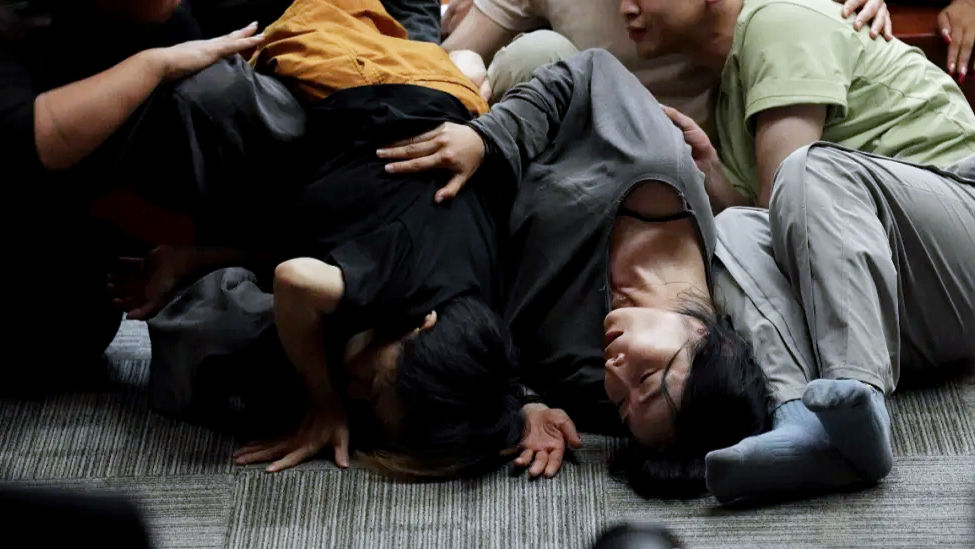
I am deeply grateful for everyone’s support, especially those who worked and improvised with me. We laughed, shouted, played, and shared our different kinds of “imperfection.” Together, we created a small clown world that existed for only two days.
Through this experience, I also made many new friends from northern China. I never expected that among these thirteen participants, there would be so many talented and inspiring people.
(Photo: Entrance of the organizer, Beijing Zhongyu Future Arts Training Co., Ltd.)
The workshop started from physical action, moving from individual exploration to collaboration, from free improvisation to the facilitator’s guidance.
Two days and twelve hours may not seem like a long time, but our group of thirteen participants entered the process very quickly.
What I experienced was not only a performance skill, but also a different philosophy of performance.

One exercise left a particularly strong impression on me.
The facilitator asked us to keep looking at the audience, openly share the “embarrassing” moments happening in the present, and immediately respond to the audience’s reactions. We had to complete this exchange within a very short time.
For me, it was extremely challenging.
But precisely because it was difficult, it was also deeply inspiring. It placed the part of myself that I usually avoid directly in front of the audience.
I learned clowning because I wanted to find a breakthrough in my artistic practice.
I want to strengthen my ability to communicate and improvise on stage.
For me, clowning is a path toward authenticity, accepting reality, and actively responding to the audience.
It is not simply about becoming better at “performing.” Instead, it forces me to face a deeper question:
Can I bring my present self to the audience — including my awkwardness, hesitation, clumsiness, and uncertainty?
Of course, my work can be angry. It can criticize things that are unreasonable.
But I believe these feelings are already part of my existence.
What I want is not to turn the audience into the target of my anger, but to allow them to understand my situation and my real emotions.
Perhaps humor is one of the most powerful ways to create a shared relationship between performer and audience.

So how can I present humor and my authentic self more honestly on stage?
This workshop made me realize that clowning is a particularly valuable method for me, one that is different from traditional theatre.
It can help me develop my stage presence, but more importantly, it allows me to rethink the parts of myself that I used to dislike.

I have always felt that there is something “foolish” in my personality — or perhaps a kind of foolishness that tries to appear clever.
Unexpectedly, this was exactly the part of myself that I discovered during the workshop and that I can transform into artistic material.
The “imperfection” I talk about is not simply disability in a narrow sense. It refers to something more internal and universal: the awkwardness, vulnerability, hesitation, and unfinished parts that exist in everyone.
I believe these qualities can become artistic resources and continue to appear in my future works.
Originally, I only wanted to bring clowning into my existing artistic practice.
But now I feel that I may want to continue exploring further and create works that are more directly connected with clown theatre.

Maybe it begins with allowing my own “imperfection.”
And perhaps, slowly, these imperfections can become materials that truly belong to my art.

Photos from the workshop are copyrighted by “Something Happens” and “Open Gate Theatre.
Photographers: Haidai and Hailei.
Special thanks to the Beijing organizers, including Xiao Yu and all the partners who supported me during this journey.


Comments